
Featured Flow Control Products: High-Integrity Series
Explore our flagship certified industrial valve lines, engineered with in-house foundries and high-purity vulcanization to satisfy ISO 9001 and CE requirements.
Macro Industry Solutions: Eliminating Leak Paths in Aggressive Media
Evaluating the systemic transition from pinned shafts to integral spline/hex pinless architectures in critical fluoropolymer-lined isolation systems.
Hermetic Pinless Torque Transmission
Traditional through-pin butterfly valves introduce mechanical perforations through the fluoropolymer encapsulation of the disc. Under severe chemical thermal cycling, corrosive fluids like wet chlorine, hydrochloric acid, and sulfurous slurries permeate the pin boundary, inducing galvanic corrosion and catastrophic stem shearing. Our Wholesale PTFE Lined Pinless Butterfly Valve utilizes internal drive geometries—such as high-precision polygonal drive shafts or splined disc inserts—completely encasing internal metallurgy inside a continuous, isostatically molded PTFE/PFA jacket.
Isostatic Compression & Zero Cavity
Lining integrity depends fundamentally on uniform density. Tianjin Top Valve utilizes high-pressure virgin DuPont or Daikin granular PTFE/PFA resin, isostatically compressed under computer-controlled vacuum conditions to a minimum lining thickness of 3.0mm to 4.5mm. This eliminates micro-porosity, lowers gas permeation coefficients by 400% compared to transfer-molded alternatives, and satisfies the demanding criteria of ISO 15848-1 Class AH fugitive emission benchmarks.
Dynamic Energized Elastomeric Backing
Operating between -40°C and +200°C (-40°F to 392°F), thermal expansion differential between fluoropolymers and metallic ductile iron bodies typically provokes cold flow and internal leakage. Our proprietary dual-compound dynamic energizers—featuring silicone or high-grade EPDM cushion rings embedded behind the virgin PTFE seat—maintain constant sealing pressure across thousands of actuation cycles, yielding authentic bidirectional ANSI FCI 70-2 Class VI bubble-tight shutoff.
As chemical process engineering plants increase operating temperatures and chemical concentrations to maximize synthesis yields, traditional industrial elastomer valves face accelerated vulcanization breakdown and swelling. A pinless PTFE-lined disc removes the single most prevalent structural vulnerability of lined butterfly valves: leakage around the disc drive pins. By housing the high-tensile 17-4PH or ASTM A564 Grade 630 stainless steel stem inside blind polygonal broaches within the disc, media contact with structural metal is impossible, offering engineering contractors an unbreachable chemical barrier.
Worldwide Commercial Dynamics in Fluoropolymer Valve Supply
Global supply chains face raw material volatility, strict emission limits, and the shift toward integrated manufacturing.
Vertical Integration Advantage
Global engineering, procurement, and construction (EPC) conglomerates are actively rationalizing their vendor base, turning away from trading intermediaries and fragmented assemblers. With groups operating dedicated valve foundries (established 1996) alongside dedicated rubber and fluoropolymer compounding facilities (operating since 1987), Tianjin Top Valve completely eliminates third-party component markup and quality variation across multiple subcontractors.
Decarbonization & Life Cycle Costing (LCC)
Global plant operators are revising their Capital Expenditure (CAPEX) vs Operational Expenditure (OPEX) models. In caustic chlor-alkali and copper refining plants, installing lower-cost generic rubber valves produces frequent shutdowns, averaging $45,000 per hour in unplanned downtime. By selecting wholesale pinless PTFE lined designs, operators achieve 300% longer maintenance intervals, driving down total cost of ownership by up to 64% over an 8-year operational window.
PFAS Regulation Preparedness
As the European Chemicals Agency (ECHA) and United States EPA evaluate persistent fluorinated substances, our metallurgy and polymer laboratories are driving development of high-density ultra-high-molecular-weight polyethylene (UHMWPE) and non-fluorinated polymer barriers for applications with lower thermal demands, ensuring supply continuity as environmental mandates change.
Pinless PTFE vs. Traditional Pinned & Rubber Lined Valves
Direct technical audit comparing structural failure points, pressure containment, and sealing reliability under harsh operating duties.
| Evaluation Parameter | Top Valve PTFE Lined Pinless | Conventional Pinned PTFE Valve | Standard EPDM/NBR Lined Valve |
|---|---|---|---|
| Disc-to-Stem Sealing Architecture | Hermetic Blind Internal Hex/Spline | Through-disc pins with PTFE blind caps | Through-pin or single shaft with rubber seal |
| Acid & Solvent Resistance (pH 0-14) | Universal (HF, Aqua Regia, Oleum) | Liner vulnerable to pin-cap crevice permeation | Restricted to mild dilute chemicals |
| Working Temperature Range | -40°C to +200°C (-40°F to 392°F) | -20°C to +150°C (pinned leaks under thermal shock) | -10°C to +110°C (elastomer degradation) |
| Spark Testing Quality Standard | 100% 20 kV Non-Destructive Spark Test | Random spot testing (typically 10-14 kV) | Not applicable for thick synthetic rubber |
| Stem Seal Fugitive Emissions | ISO 15848-1 Class AH / TA-Luft Compliant | Class B or C under extended cycling | Standard packing (vulnerable to aging) |
| Friction Factor & Actuation Torque | Ultra-low PTFE coefficient (μ = 0.04-0.10) | Moderate (increased by pin drag) | Higher (rubber hysteresis friction drag) |
Localized Application Scenarios in Demanding Environments
Engineered to excel in chemical syntheses, battery cathode recovery, cleanrooms, and seawater pipelines.
Semiconductor Ultra-Pure Chemicals
Manufacturing modern 3nm/5nm microelectronics requires ultra-pure electronic-grade chemicals (UPW, high-purity hydrogen peroxide, sulfuric acid, and hydrofluoric acid) with zero ionic trace leaching. Pinless PTFE-lined valves avoid metallic friction fragments, eliminating micro-contamination in cleanroom fabrication loops.
Lithium-Ion Battery Hydrometallurgy
Black mass recycling and precursor cathode active material (pCAM) production process concentrated nickel-cobalt-manganese sulfate streams at elevated temperatures under acidic leaching conditions. Our PTFE disc linings resist localized erosion from slurries while stopping severe oxidative chemical attack.
Chlor-Alkali & Bleach Production
Chlorine plants face dry and wet chlorine gas, sodium hypochlorite, and caustic soda. These chemicals quickly degrade standard elastomers and cause stress cracking in 316 stainless steel. Isostatically molded pinless PTFE jackets seal these volatile media without premature seat hardening.
Flue Gas Desulfurization (FGD)
Power plant scrubbers mix sulfur dioxide gases with lime slurry, chlorides, and gypsum crystals, producing a corrosive, abrasive slurry. Pinless wafer and lug valves provide full-port, unobstructed flow paths that resist scale accumulation and prevent structural failure from particle entrapment.
Localized Support, Regulatory Compliance & Traceability
From optical spectrographic melt testing to 100% hydrostatic and spark verification under audited ISO frameworks.
Material Traceability: EN 10204 3.1
Every casting run in our foundry undergoes optical emission spectrometry to confirm nodularity in ductile iron (ASTM A395 / GGG40.3) and precise nickel-chromium ratios in stainless steel. Material test reports (MTR) according to EN 10204 3.1 accompany every shipment, guaranteeing complete heat number traceability down to the individual valve tag.
Global Dimensional Interchangeability
Valves are engineered to comply with EN 558 series 20, API 609 Table 1, and ISO 5752 short face-to-face dimensions. Flange bolt patterns match ASME B16.5 Class 150, EN 1092-1 PN10/PN16, and JIS B2239 10K specifications, allowing seamless field drop-in replacements during brownfield plant modernization.
Direct Engineering Consultation
Rather than working through external distributors, clients communicate directly with our engineering department. Our specialists assist EPC teams with fluid flow velocities, torque margin sizing for pneumatic/electric actuators, and custom liner compound selection for problematic mixed-acid streams.
Technology Roadmap: Intelligent Fluoropolymer Flow Control
Leading the valve industry into the smart era with digital sensor integration, carbon-reinforced seats, and AI-enabled lifecycle prediction.
IoT Wear & Permeation Sensors
Our upcoming generation of industrial PTFE-lined valves integrates micro-dielectric grid sensors directly into the elastomeric backing behind the fluoropolymer. These sensors track impedance changes caused by early-stage acid permeation long before fluid reaches the metal body, triggering predictive maintenance alerts through industrial Modbus or WirelessHART networks.
Carbon-Nanotube Reinforced PTFE
To control electrostatic accumulation during high-velocity transfers of non-conductive volatile solvents (toluene, heptane, diethyl ether), our R&D team developed conductive carbon-doped fluoropolymer matrices. These materials maintain an electrical surface resistance below 106 ohms, helping avoid static spark discharges while preserving chemical inertness.
Digital Twin Fluid Dynamics Simulation
Every newly designed disc contour undergoes extensive computational fluid dynamics (CFD) modeling in our research laboratories. By profiling disc curvature, we reduce dynamic torque by 28% and eliminate cavitation zones around disc sealing edges, resulting in smoother flow regulation and extended seat lifespan.
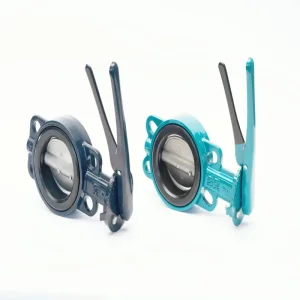
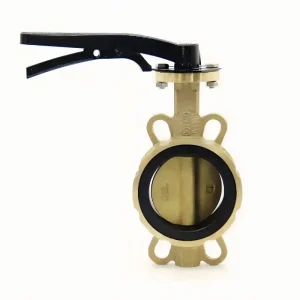
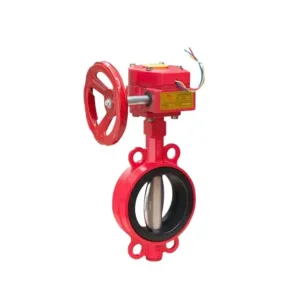
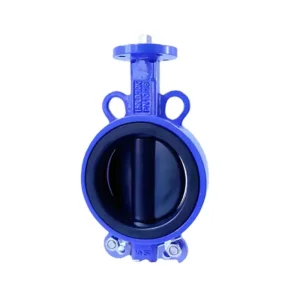
Engineered Valves for Severe Service, Fire & Maritime Lines
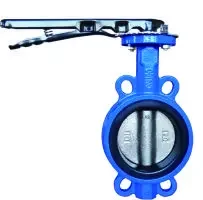
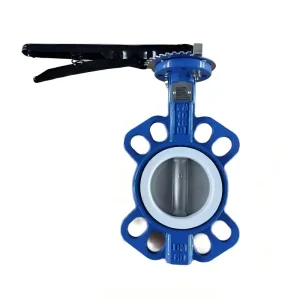
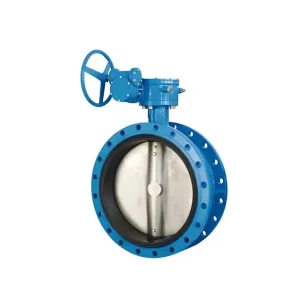
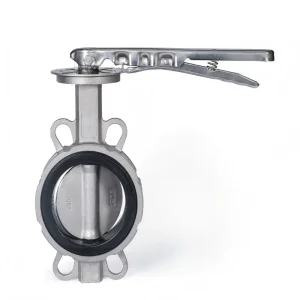
Review our additional wholesale-ready industrial valve designs, manufactured and hydrostatically tested to comply with international pipeline regulations.
Frequently Asked Questions: Technical Engineering & Sourcing
Clear answers addressing valve design, material integrity, testing protocols, and customization options.
Why is the pinless disc construction mechanically superior in PTFE-lined butterfly valves?
Traditional designs secure the disc to the stem using mechanical taper pins, bolts, or roll pins that penetrate the fluoropolymer lining. Under alternating thermal cycles and corrosive fluid attack, dynamic vibrations loosen pin seals, creating leak paths that allow aggressive media to corrode the inner carbon or stainless steel shaft. Our pinless system incorporates an internally splined, hexed, or double-D broached connection fully shielded inside the molded PTFE/PFA envelope, removing mechanical perforations and significantly reducing shaft-fatigue failures.
How does your factory confirm the absence of pinholes and micro-cracks in the liner?
Every single PTFE/PFA lined valve undergoes a non-destructive electrostatic spark test at a minimum of 20,000 Volts (20 kV) in accordance with ASTM D5162 and DIN EN 14430. Any micro-fissure, porosity channel, or void instantly triggers an electrical ground fault, prompting immediate rejection of the component before assembly. In addition, 100% of finished assemblies undergo hydrostatic shell testing at 1.5× PN rating and bubble-tight seat tests at 1.1× PN rating according to API 598 and ISO 5208.
What is the standard lead time and capacity for wholesale EPC framework contracts?
Because we operate our own group foundry (producing up to 800 metric tons of iron and stainless castings per month) and in-house elastomer vulcanization workshops, we maintain standard lead times of 15 to 25 calendar days for batch orders up to 1,000 units. Critical safety stock of standard wafer, lug, and flanged patterns (sizes DN50 through DN600 / 2" through 24") is kept semi-machined to fulfill urgent plant replacement shipments within 72 hours.
What automation and actuation packages are supported?
All valve bodies feature integral ISO 5211 direct-mounting top flanges, allowing streamlined mounting of quarter-turn pneumatic actuators (rack-and-pinion or scotch-yoke), intelligent electric modulators (4-20mA / HART / Profibus compatible), and declutchable manual worm gear overrides without bulky brackets. Because pure PTFE has an exceptionally low friction coefficient, sizing requires smaller, more energy-efficient actuator packages.
