
Featured Industrial Pipeline Flow-Control Assemblies
Standard and customized high-integrity quarter-turn and non-return valves engineered under strict ISO 9001 and CE/PED quality criteria, manufactured with group in-house foundry and elastomer moulding assets.
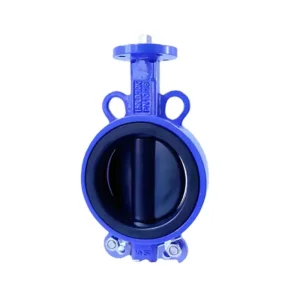
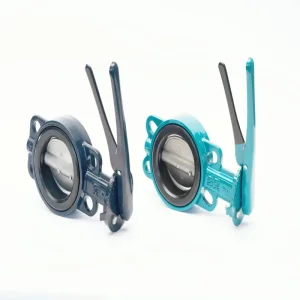
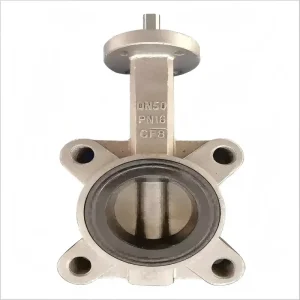
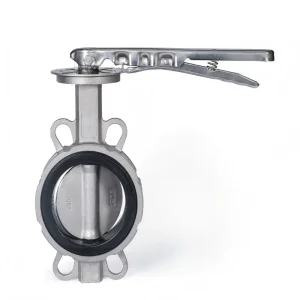
Global Industrial Status of Half-Shaft Wafer Butterfly Valves
Across modern process automation, municipal water distribution, seawater desalination, and district cooling infrastructure, procurement criteria have shifted definitively away from high-loss through-stem configurations toward aerodynamically optimized half-shaft (stub-shaft) designs.
Overcoming Conventional Flow Choke
Traditional concentric butterfly valves employ a single through-shaft running continuously through the center of the valve disc. In nominal diameters from DN50 to DN600 (2" to 24"), this through-shaft consumes significant cross-sectional area, generating severe vortex shedding, boundary-layer separation, and elevated head loss. Wholesale buyers specifying half-shaft wafer butterfly valves gain an ultra-slim disc profile that increases net flow area by up to 18%, substantially lowering total pumping energy over a 20-year pipeline lifecycle.
Eradicating Disc Pin Corrosion & Shearing
Older resilient-seated designs secure the disc to the stem via transverse taper pins or set screws. In harsh saline, brackish, or chemical services, galvanic coupling between the pin and disc material precipitates crevice corrosion, leading to pin shearing, disc detachment, and unannounced line shutdowns. Tianjin Top Valve manufactures half-shaft assemblies utilizing precision broached splines, double-D flats, or hex-drive interfaces nestled deep inside disc hubs—entirely eliminating through-face holes and external leak paths.
Radical Footprint & Actuation Economy
Because the half-shaft disc profile balances hydrodynamic forces across the leading and trailing edges, dynamic operating torques are diminished by 25% to 35% compared to traditional through-shaft geometries. This torque drop directly translates to smaller actuator frames—whether selecting quarter-turn worm gearboxes, multi-turn electric actuators, or rack-and-pinion pneumatic cylinders. Contractors achieve massive savings in structural support weight, electrical cabling size, and compressor power budgets.
Engineering Blueprint: Half-Shaft vs. Through-Shaft Configuration
A rigorous engineering evaluation of structural mechanics, torsional load distribution, disc hydrodynamic coefficients, and fugitive emission barriers according to API 609 Cat A and EN 593 standards.
| Evaluation Parameter | Top Valve Half-Shaft (Stub-Shaft) Wafer | Legacy Through-Shaft Wafer | Engineering Impact / Advantage |
|---|---|---|---|
| Disc Drive Mechanism | Internal Double-D, Spline, or Hexagonal Hub | Taper Pins or Through-Disc Dowels | Zero Disc Penetration No galvanic crevice risk |
| Net Flow Coefficient (Cv) | High (Low restriction, razor-edge disc profile) | Restricted (Bulky central disc collar) | +20-28% Cv Lower head loss across high velocity lines |
| Breakaway & Sealing Torque | Low (Optimized disc-to-elastomer interference) | High (Excessive friction on oversized stem bore) | 30% Downsizing Smaller electric/pneumatic actuators |
| Stem Seal Integrity | Tri-tier O-rings + Primary seat neck compression | Secondary packing gland compression only | ISO 15848-1 Zero fugitive stem emissions |
| Maintenance & Seat Replacement | Modular cartridge seat; stub shafts pull outwards | Pins must be drilled out; frequent disc damage | Fast Overhaul 70% reduction in field maintenance hours |
| Applicable Pressure Class | PN10, PN16, Class 150 (200 PSI working rating) | PN10, PN16 | Full bi-directional bubble-tight shutoff (EN 12266-1 Rate A) |
Dual-Shaft Torsional Synchronization
In our half-shaft architecture, the upper drive shaft transmits rotational torque directly through an ISO 5211 top mounting flange, while the lower dummy shaft (trunnion) functions as an ultra-rigid alignment guide. Both shafts are seated in self-lubricating PTFE-lined bronze or reinforced polymer bushings. This dual-support geometry eliminates shaft deflection under high differential pressure (ΔP up to 16 bar), preventing the disc from binding or galling against the resilient seat liner.
Engineered Anti-Blowout Protection
Safety compliance under PED 2014/68/EU demands positive stem blowout prevention. Top Valve half-shaft stems are designed with integral collar grooves secured via heavy-duty stainless internal retaining rings and top-plate retainers. Even if high line pressure surges or cavitation spikes occur, the stem remains mechanically locked inside the body journal, protecting plant personnel and nearby instrumentation.
Metallurgical Matrix & Elastomer Formulations
Direct factory control from molten metal casting to molecular rubber curing guarantees traceable physical performance and chemical compatibility across diverse process media.
Body Metallurgy: Ductile Iron & WCB
Body castings are poured in our dedicated foundry using Grade GGG40 / GGG50 (EN-GJS-400-15 / EN-GJS-500-7) ductile iron or ASTM A216 WCB carbon steel. The high tensile strength and nodularity (>85%) prevent body cracking under pipe thermal expansion, water hammer, or bolt over-tightening. Electrostatic fusion-bonded epoxy (FBE) coating (min 250 µm thickness) satisfies corrosive soil and immersion conditions.
Disc Alloys: Duplex, Bronze & CF8M
To suit varying corrosivity, our CNC lines finish discs in ASTM A351 CF8M (316 SS), Super Duplex 2205/2507, and Nickel-Aluminum Bronze (C95800 / EN CC333G). Discs feature hand-polished, spherical sealing edges with mirror finishes (Ra < 0.4 µm). This micro-smooth contact minimizes seat friction, wipes away particulates, and extends rubber seat cycle life past 50,000 operations.
Elastomer Compounding Heritage Since 1987
While third-party assemblers buy generic rubber seats, our group’s Dongfang Rubber Factory has compounded specialized elastomers for over three decades. We produce WRAS-approved EPDM for potable water (toxic-free, chloramine resistant), high-nitrile NBR for hydrocarbon fuels, Viton (FKM) for corrosive organics at elevated temperatures, and molded Virgin/Conductive PTFE liners.
Mission-Critical Deployment Scenarios
Engineering case studies demonstrate where wholesale half-shaft wafer butterfly valves resolve longstanding operating vulnerabilities.
1. Municipal Potable Water & WRAS Networks
In drinking water distribution networks throughout the UK, Europe, and the Middle East, sanitary approvals and microbial inertness are mandatory. Our half-shaft wafer valves fitted with WRAS-approved EPDM seats prevent bacterial harbor points because the smooth disc profile has no transverse pin cavities. The compact wafer face-to-face (EN 558 Series 20) easily drops into tight subterranean meter vaults and pumping stations.
2. Commercial HVAC & District Energy Cooling
High-rise chiller plants and regional district cooling headers circulate tens of thousands of cubic meters per hour. Traditional through-stem valves accumulate staggering parasitic pumping losses. Replacing them with our half-shaft wafer butterfly valves decreases pumping head resistance across thousands of branch lines, enabling LEED-certified building developers to cut electrical energy tariffs significantly.
3. Seawater Desalination (SWRO) & Marine Ballast
In reverse osmosis high-salinity intake and shipboard ballast water treatment systems, high chloride concentrations ravage conventional pins. Top Valve’s half-shaft wafer units with C95800 Aluminum Bronze or Duplex 2205 discs isolate the stub shafts from fluid contact. Combined with rubber-lined bodies, no raw seawater ever touches structural ductile iron, providing lifetime corrosion immunity.
4. Industrial Slurry & Chemical Effluent
Abrasive particulates in wastewater, mineral tailings, and lime milk rapidly erode protruding stem pins. The smooth, contoured half-shaft disc enables continuous scouring without creating dead-zones where lime or solids can accumulate. Paired with wear-resistant NBR or chemically inert PTFE liners, the assembly provides an uninterrupted boundary surface that resists scour and erosion.
Tianjin Top Valve: Vertical Integration Since 1987
Located in Wuxia Industrial Park, Tianjin, China, our 23,000 m² modern manufacturing complex integrates casting, rubber vulcanization, CNC machining, and automated hydrostatic testing under single-source management.
In-House Foundry & Spectrometric QA
Unlike trading houses that assemble outsourced third-party castings of dubious metallurgy, our group has operated Tianjin Donglian Valve Factory since 1996. Every ladle of molten iron or stainless steel is verified via optical emission spectrometers prior to pouring, ensuring carbon equivalent, nodularity, and chemical composition adhere strictly to EN 1563 and ASTM A536 standards.
Zero-Defect 100% Hydrostatic Inspection
We do not rely on AQL statistical batch sampling. Every single half-shaft wafer butterfly valve manufactured undergoes mandatory hydrostatic shell testing at 1.5× PN (24 bar for PN16) and bi-directional seat leakage testing at 1.1× PN (17.6 bar for PN16) in compliance with ISO 5208 / EN 12266-1 Rate A (zero allowable bubble leakage) before receiving its QC acceptance stamp.
Global Compliance & Traceability
Our management framework is certified to ISO 9001 (Quality), ISO 14001 (Environmental), and ISO 45001 (Health & Safety). Products carry full CE conformity marks under European Pressure Equipment Directive (PED 2014/68/EU Module H) and specific drinking water approvals including WRAS (Water Regulations Approval Scheme) for models 4020G, 4020L, 4325G, and 4325L.
The Next Horizon of Butterfly Valve Engineering
Anticipating the technological demands of Industry 4.0, decarbonized district energy grids, and ultra-harsh seawater processing.
IIoT-Ready Smart Sensing Shafts
Integrating non-invasive fiber-optic micro-strain sensors directly inside lower stub-shaft journals. This enables real-time transmission of torque variance, dynamic seat wear, and water-hammer vibration data to plant SCADA networks, facilitating predictive maintenance before any packing or seat degradation can occur.
Bio-Synthetic EPDM & Low-Carbon Casting
In accordance with global ESG mandates, Top Valve’s rubber laboratories are piloting plant-based monomer elastomers alongside 100% scrap-recycled ductile iron melted in clean electric induction furnaces, lowering the embodied carbon of each valve assembly by 42% over 2020 benchmarks.
Advanced Ceramic & Diamond-Like Disc Coatings
For abrasive lithium battery slurry, flue-gas desulfurization (FGD), and mining paste applications, our R&D group is applying thermal-spray ceramic disc coatings that achieve surface hardness ratings up to HRC 72, preventing abrasion wear while retaining resilient elastomer sealing tightness.
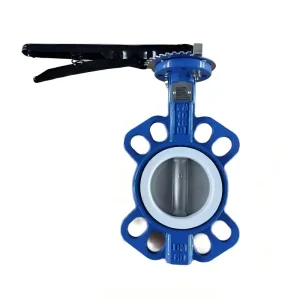
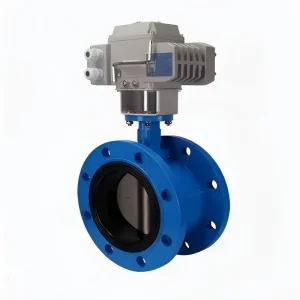
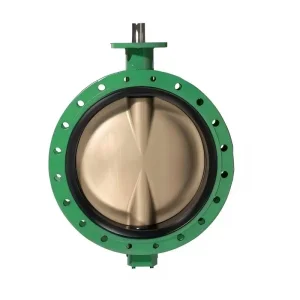
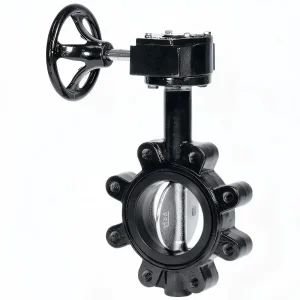
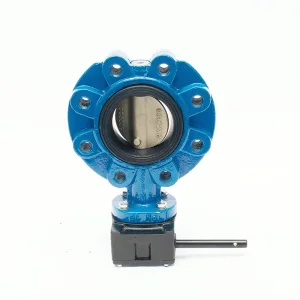
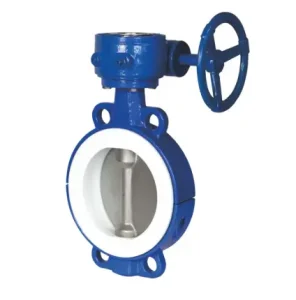
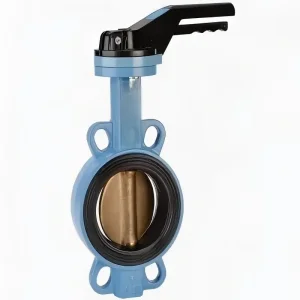
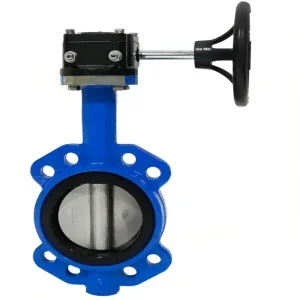
Engineered Quarter-Turn & Lined Control Valves
Explore our precision-machined PTFE lined, flanged, marine-grade bronze, and electrically actuated configurations tailored for heavy industrial service.
Frequently Asked Engineering & Procurement Questions
Detailed technical clarification for EPC consultants, valve distributors, and plant engineers specifying half-shaft wafer butterfly assemblies.
What defines a "half-shaft" (or stub-shaft) wafer butterfly valve, and how does it mechanically differ from a through-shaft model?
Why is the pinless disc connection of a half-shaft valve superior in seawater and chemical pipelines?
Which international flange standards are compatible with your wholesale wafer butterfly valves?
How does Tianjin Top Valve guarantee elastomer resilience and seat lifespan?
What hydrostatic and pneumatic pressure testing standards are applied prior to factory dispatch?
Can actuators be directly mounted onto your half-shaft wafer butterfly valves?
Direct Factory Sourcing & Engineering Collaboration
Connect directly with our senior valve engineering department in Tianjin. Whether you require standard WRAS-approved water valves, customized high-nickel aluminum bronze alloys for offshore platforms, or OEM container-load manufacturing agreements, our team responds with comprehensive CAD drawings, 3D step models, and verified datasheets within 24 hours.
