Precision Non-Return Valves for High-Rise and Heavy Industrial Applications
Engineered for high-flow urban distribution, municipal water mains, and industrial cooling loops in the Tokyo metropolitan area.
1. The Tokyo Industrial & Infrastructure Ecosystem: Demands on Modern Check Valves
The Greater Tokyo Area, anchored by the Keihin Industrial Zone spanning Tokyo, Kawasaki, and Yokohama, forms one of the world's most densely concentrated hubs of high-efficiency thermal power, semiconductor manufacturing, petrochemical refining, and deep-underground civil hydraulic infrastructure. Unlike conventional continental installations, piping design in Tokyo is dictated by severe spatial constraints, stringent seismic mitigation protocols (enforced by the Ministry of Land, Infrastructure, Transport and Tourism - MLIT), and ultra-low noise thresholds mandated across high-density urban areas.
Check valves (also designated as non-return or reflux valves) fulfill an existential safeguarding role throughout Tokyo's municipal and industrial pipelines. Primary tasks include instantaneous reversal interception during transient flow states, pump station isolation against rapid backpressure surges, and complete elimination of hydraulic water hammer (shock wave transients capable of shattering pipeline welds and compromising subterranean tunnels). In critical applications such as the Tokyo Waterfront Area District Heating and Cooling (DHC) systems or deep storm-surge pump chambers like the Metropolitan Area Outer Underground Discharge Channel (G-CANS), check valve failure is not merely a maintenance issue—it represents an immediate existential threat to metropolitan resilience.
Technical Field Insight: High-rise commercial architectures in districts like Shinjuku, Roppongi, and Otemachi operate vertical booster pumping systems exceeding 200 meters of static head. Under sudden motor cutoff, reverse fluid acceleration can exceed 15 m/s² within 40 milliseconds. Check valves deployed here must execute silent, spring-assisted, zero-slam closure before flow reversal initiates, guaranteeing pressure spikes remain well below the yield limits of JIS B 2220 / JIS B 2239 flanges.
2. Comprehensive Engineering Topology: Selecting the Right Check Valve Mechanism
Procurement teams and mechanical engineers working on international projects in Japan must evaluate multiple dynamic flow variables: head loss coefficient (Kv/Cv), cracking pressure, closing speed, suspended solids capacity, installation orientation, and structural mass. Below is an engineering comparison matrix of primary check valve architectures manufactured by our group for Japanese and global procurement standards.
| Valve Topology | Standard Construction | Closure Dynamics & Noise | Pressure Loss (Head Loss) | Primary Application in Tokyo Projects |
|---|---|---|---|---|
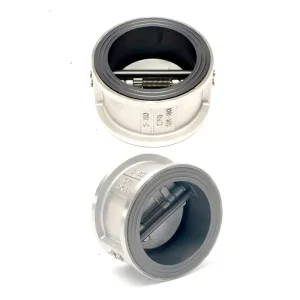
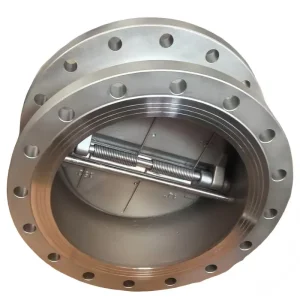
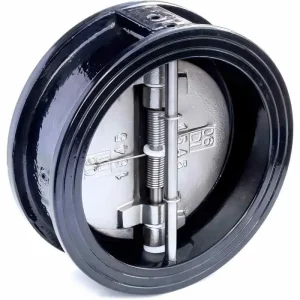
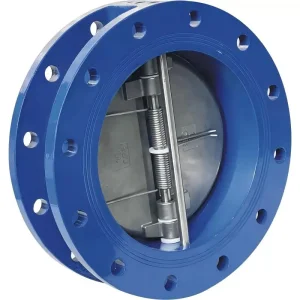
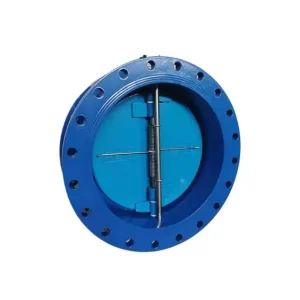
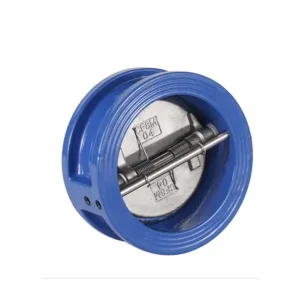
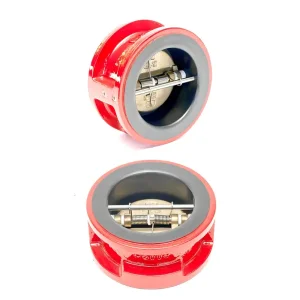
| Dual Plate Wafer / Flanged | Ductile Iron (FCD450) / CF8M disc, Inconel 718 / 316 spring, EPDM/NBR/Viton seat | Ultra-fast closure (<0.12s); minimal water hammer; resilient spring assist | Low-to-medium; dual semicircular flow channels promote laminar passage | Tokyo commercial HVAC risers, cooling towers, space-constrained plant rooms |
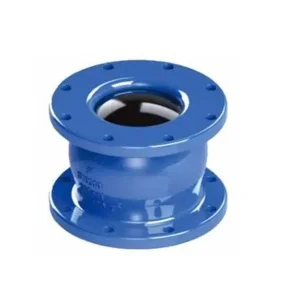
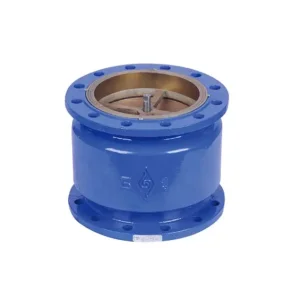
| Silent Lift Check (Poppet Type) | Ductile Iron body, SS304/SS316 disc, center-guided bronze/SS bushing | Zero-slam; closure occurs precisely at zero velocity before reversal begins | Moderate; central bulb contour designed via CFD to streamline flow diversion | Potable water booster pump discharges, skyscraper municipal feed risers |
| Full Rubber Coated Flap Type | Ductile Iron fully encapsulated in EPDM or NBR rubber vulcanization | Cushioned closure; resilient seating tolerates particulate entrapment without leak | Extremely low; unobstructed straight-through swept flow path | Tokyo Bay raw seawater cooling, sewage transfer, industrial effluent loops |
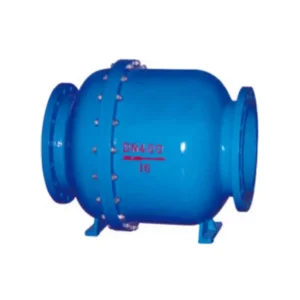
| Micro-Resistance Ball Check | Epoxy-coated Ductile Iron body, NBR-covered hollow steel ball | Self-cleaning rolling ball mechanism; non-clogging under heavy solids load | Minimal; full unobstructed bore with no internal hinges or shafts | Stormwater mitigation vaults, subterranean wastewater treatment plants |
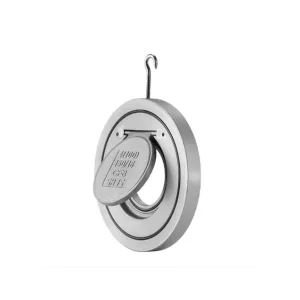
| Single Disc Thin Wafer | Carbon Steel / CF8M / CF3M body and disc, metal-to-metal or O-ring seal | Gravity/short-swing assisted; lightweight; thin face-to-face profile | Medium; restricted disc swing angle in narrow pipe diameters | General process lines, auxiliary utility headers, chemical handling skids |
Fluid Dynamic Optimization (CFD Validation)
Every check valve body contour and internal disc curvature manufactured in our Tianjin facility undergoes Computational Fluid Dynamics (CFD) modeling to identify recirculating eddies and boundary separation zones. In dual-plate configurations, independent leaf suspension with specialized torsion springs balances cracking sensitivity against reverse momentum dampening.
This design minimizes turbulence across JIS 10K, 16K, and 20K flange configurations, preserving hydraulic energy across massive urban circulation schemes.
Seismic Acceleration Resilience (JIS Standards)
Piping systems in Tokyo must withstand seismic spectral accelerations exceeding 1.0g under Great East Japan Earthquake design criteria. Rigid, heavy swing check valves with high-mass counterweights can experience catastrophic hinge pin shearing during horizontal and vertical seismic shear shocks.
Our dual-plate and silent poppet designs feature symmetrically balanced, low-inertia discs supported by internal guide shafts, preventing mechanical dislocation during high-frequency ground movement.
3. Vertical Integration: How Our In-House Foundry & Rubber Plants Deliver Concrete ROI
In the global valve marketplace, many international trading houses and assembly shops outsource castings and rubber sealing elements to fragmented tier-3 workshops. This fragmentation introduces dangerous metallurgical inconsistency, variable elastomer curing, porosity defects, and uncontrolled lead times. Our parent group eliminates these variables through total ownership of the manufacturing lifecycle spanning over three decades in Tianjin, China.
In-House Rubber Compound & Vulcanization (Est. 1987)
Sealing failure in check valves almost always begins at the elastomer-metal interface. Through our Tianjin Dongfang Rubber Factory (operating continuously since 1987), raw elastomer polymers (EPDM, NBR, FKM, Silicone) are compounded, mixed, and hot-vulcanized on site under tight rheometer monitoring.
Our formulations achieve minimal compression set (<18% after 1,000 hours at 100°C), superior anti-aging resilience against chloraminated municipal water, and full WRAS / FDA compliance for zero toxic leaching into potable water distribution.
Autonomous Foundry & CNC Precision Machining (Est. 1996)
Operating through Tianjin Donglian Valve Factory (since 1996), we melt and cast ductile iron (QT450-10, equivalent to JIS FCD450), cast steel (WCB), and austenitic stainless steels (SCS13, SCS14) using automated resin-sand moulding lines and medium-frequency induction furnaces.
Optical emission spectrometers verify chemical stoichiometry prior to each pour. Machining is performed on multi-axis CNC horizontal centers, achieving concentricity tolerances within ±0.015 mm for flawless hinge shaft alignment and zero seat bypass.
For Tokyo procurement managers, general contractors (Taisei, Shimizu, Obayashi, Kajima), and international plant engineering firms, this integrated setup provides substantial value:
- Direct Cost Competitiveness: Elimination of multi-tier trading margins and outsourced casting markups saves 25% to 40% on bills of materials for capital projects.
- Traceability & Material Test Reports: Complete EN 10204 Type 3.1 inspection certification furnished with heat-number-traceable mechanical properties, tensile testing, and Charpy V-notch impact values.
- Streamlined Logistics via Tianjin Port to Tokyo/Yokohama: Direct maritime shipping routes link Tianjin Xingang with Tokyo Port (Ohi Container Terminal) and Yokohama Port with transit times as short as 4 to 6 days.
4. Tokyo Regional Engineering Applications & Case Scenarios
From subterranean flood detention basins to high-density server complexes, check valves perform under demanding urban engineering conditions across the Kanto plain.
Tokyo Waterfront Subcenter DHC
Large chilled-water circulating pumps require high-capacity dual-plate wafer check valves with low pressure drop. Quick spring return prevents hydraulic surges during alternating chiller cycling, protecting extensive underground secondary utility loops across Odaiba and Ariake.
Minato & Shinjuku High-Rises
In 40-to-60 story vertical towers, silent lift check valves with soft EPDM seats eliminate structural noise transmission through domestic water risers while withstanding high static heads up to 2.5 MPa without seat leakage or valve slam.
Koto & Edogawa Lowland Drainage
Low-elevation eastern Tokyo wards rely on high-volume axial drainage pumping stations. Micro-resistance rubber-coated flap and ball check valves provide wide, debris-tolerant discharge passages that prevent Tokyo Bay tidal ingress during typhoon surges.
Keihin Industrial Corridor Pipelines
Chemical terminals and petrochemical refining facilities along the Kawasaki-Yokohama waterfront demand stainless steel (SCS14 / 316) wafer lift and dual-plate check valves with PTFE and FKM seals, resisting hydrocarbon vapors, saline sea fog, and aggressive cooling water.
Inzai & West Tokyo Data Centers
Hyperscale server cooling loops mandate 24/7 continuous uptime. Dual-plate non-slam check valves maintain continuous loop pressure without cavitation, offering verified reliability that safeguards servers from cooling interruption during pump changeovers.
Tokyo Waterworks Bureau Distribution
Buried clean-water trunk pipelines utilize full-bore, resilient-seated gate and silent check valves with fusion-bonded epoxy (FBE) coatings exceeding 250 microns, ensuring long service life without electrolytic corrosion in wet subterranean soils.
5. Emerging Industry Trends: Decarbonization, Smart Monitoring & Low-Loss Flow Controls
The global push toward carbon neutrality by 2050, combined with Japan’s strict Energy Conservation Act (Shoene-ho), has transformed the valve engineering landscape. No longer viewed simply as passive mechanical fittings, check valves are now evaluated by their cumulative lifecycle parasitic energy consumption and integration with smart facility telemetry.
Parasitic Pressure Drop Minimization
Every fraction of a kilopascal lost across a check valve forces upstream booster pumps to consume additional kilowatt-hours. In large-scale continuous pumping operations (such as Tokyo's wastewater reclamation loops), reducing valve resistance coefficients (ζ) yields tangible electrical savings.
Our latest wafer lift and dual-plate check valve profiles employ aerodynamically contoured plates and expanded internal annular flow corridors, achieving up to 22% lower head loss compared to traditional legacy designs.
Smart Acoustic & Vibration Monitoring Interfaces
Modern plant managers in advanced industrial clusters increasingly deploy non-intrusive piezoelectric acoustic sensors and tri-axial accelerometers on valve bodies. These monitor internal disc flutter, spring fatigue, and early seat leakage caused by particulate abrasion.
Our engineering team delivers custom valve body tapped bosses and mounting pads conforming to ISO 10816 vibration guidelines, enabling seamless retrofitting of IoT predictive maintenance sensors without compromising pressure boundary integrity.
Frequently Asked Questions for Tokyo & Global Procurement
Detailed technical, compliance, and supply chain insights for project managers, engineers, and supply chain directors.
How do your check valves comply with Japanese Industrial Standards (JIS B 2031, JIS B 2085)?
What mechanisms prevent water hammer in high-rise building booster systems?
Can you provide customized elastomer formulations for aggressive chemical or seawater service?
What quality testing and traceability documents accompany each export shipment?
What is the typical shipping lead time from your Tianjin factory to Tokyo Port or Yokohama Port?
How do Chinese factory-direct check valves compare with domestic Japanese brands (e.g., Kitz, Toyo, Tomoe)?
Do you support specialized OEM and private labeling for Japanese distributors?
High-Performance Check Valves & Flow Safeguards
Engineered for industrial processing, municipal wastewater, high-rise building services, and energy networks.